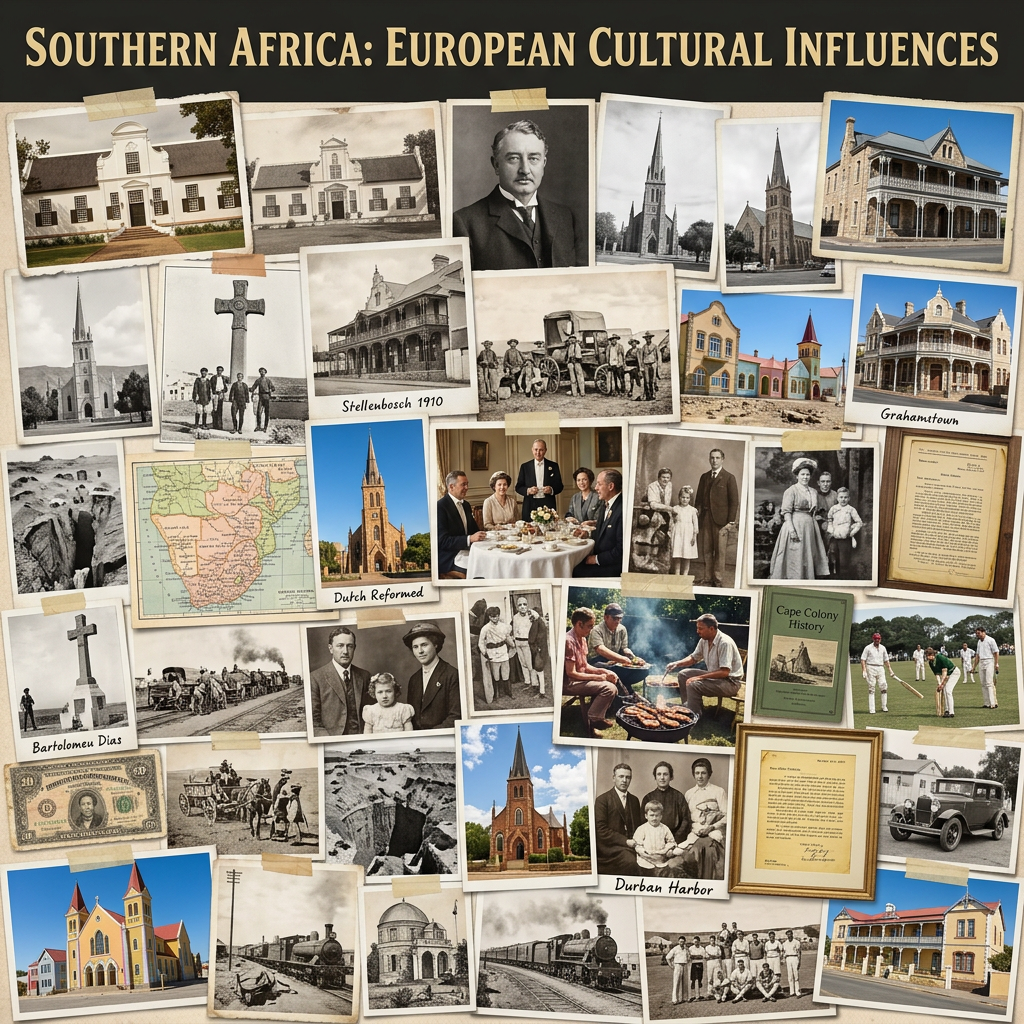
The first Europeans who rounded the southern tip of Africa were not looking for Cape Town, diamonds, or empire. They were looking for India.
When Portuguese sailors pushed down the Atlantic coast of Africa in the late 1400s, they entered waters that had long been known to African, Arab, and Indian Ocean traders—but were largely mysterious to Europe. In 1488, Bartolomeu Dias became the first European known to sail around the stormy southern cape of the continent. A decade later, Vasco da Gama completed the route to India, opening a maritime highway that would reshape southern Africa forever.
A Coastline of Encounters

At first, Europeans did not settle deeply in what is now South Africa, Namibia, Botswana, Zimbabwe, or Mozambique. The Portuguese mostly established coastal outposts farther north, especially in Mozambique, where ports linked East Africa to Goa and Lisbon.
The southern tip of Africa initially seemed less attractive. There were no obvious gold empires like those farther north, and the indigenous populations—Khoikhoi pastoralists and San hunter-gatherers—did not fit neatly into European assumptions about centralized kingdoms and trade.
Yet the Cape had one crucial advantage: fresh water and a safe anchorage for exhausted ships.
That changed everything.
The Dutch Build a Colony

In 1652, the Dutch East India Company sent Jan van Riebeeck to establish a refreshment station at the Cape of Good Hope. The small outpost at what became Cape Town was intended to supply ships traveling between Europe and Asia.
But trading stations have a habit of becoming colonies.
Dutch settlers—later known as Boers, meaning “farmers”—expanded beyond the original settlement. They brought enslaved people from Indonesia, Madagascar, India, and East Africa. Over time, a new colonial society emerged, blending Dutch, German, French Huguenot, African, and Asian influences.
Out of this mixture developed the Afrikaans language: rooted in Dutch but shaped by centuries of interaction in southern Africa.
The frontier expanded steadily inland, often violently. European settlers displaced indigenous communities, competed over cattle and grazing lands, and introduced systems of racial hierarchy that hardened over generations.
The Trek Into the Interior

The arrival of the British in the late 18th and early 19th centuries transformed the region again. Britain seized the Cape during the Napoleonic Wars to protect sea routes to India.
British rule brought new laws, new immigrants, and growing tension with the Dutch-descended Boer population. Many Boers resented British administration, especially policies concerning language, governance, and slavery.
In the 1830s and 1840s, thousands of Boers embarked on the “Great Trek,” moving inland by ox wagon in search of autonomy. The image of these wagon caravans became central to Afrikaner nationalist mythology.
The trekkers established republics in the interior, including the Orange Free State and the South African Republic.
But the interior was hardly empty.
Powerful African states already dominated the landscape. Among the most formidable was the Zulu kingdom built under Shaka in the early 19th century. European settlers entered a region shaped by African political competition, migration, and warfare as much as by colonial ambition.
The result was a tangled frontier of alliances, battles, and uneasy coexistence.
Diamonds, Gold, and Empire

If the Cape station created colonial southern Africa, minerals transformed it into a global obsession.
Diamonds were discovered near Kimberley in the 1860s. Gold followed in the Witwatersrand in the 1880s. Suddenly, southern Africa became one of the richest mining regions on Earth.
European fortunes flooded into the region. Men like Cecil Rhodes envisioned a vast British-controlled Africa stretching “from Cape to Cairo.” Rhodes gave his name to Rhodesia, the territory later divided into modern Zimbabwe and Zambia.
Mining intensified racial segregation. African laborers were recruited, taxed, controlled, and confined in systems that laid the groundwork for modern apartheid. Wealth accumulated overwhelmingly in European hands, while African communities bore the social and environmental costs of extraction.
At the same time, rival European groups fought each other. The British and the Boer republics clashed in the brutal Second Boer War. British concentration camps killed tens of thousands of Boer civilians, while African populations suffered heavily in a conflict often remembered too narrowly as a white man’s war.
The British ultimately won, paving the way for the Union of South Africa in 1910.
Europeans Beyond South Africa

European influence spread unevenly across neighboring territories.
In Namibia, German colonizers established German South West Africa. Their rule culminated in one of the 20th century’s first genocides: the extermination campaigns against the Herero and Nama peoples between 1904 and 1908.
In Mozambique and Angola, Portuguese colonialism persisted deep into the 20th century, far longer than many other European empires in Africa.
Meanwhile, in Zimbabwe, white minority rule survived even after much of Africa gained independence. The government of Ian Smith declared unilateral independence from Britain in 1965 to preserve white political dominance.
Southern Africa became one of the last great battlegrounds of colonialism.
Apartheid and the End of White Minority Rule

In 1948, South Africa’s National Party formalized apartheid—a system of racial segregation and white minority rule that controlled every aspect of life.
Pass laws restricted movement. Residential areas were segregated. Political rights were denied to the Black majority.
The system drew global condemnation, but it endured for decades through state violence, censorship, and economic power.
Resistance came from many directions: labor movements, churches, student activists, armed groups, and international pressure. Figures like Nelson Mandela became global symbols of resistance.
By the late 20th century, white minority governments across southern Africa had collapsed or negotiated transitions to majority rule. Namibia became independent in 1990. South Africa held its first multiracial democratic elections in 1994.
The era of European political domination had ended.
The Legacy That Remains

Yet the European imprint on southern Africa is everywhere.
It survives in languages like Afrikaans and English. In legal systems, railways, churches, architecture, and national borders. In vineyards around the Cape and German place names in Namibia. In cricket grounds, parliamentary traditions, and mining conglomerates.
It also survives in inequality.
Many of the region’s deepest economic divisions trace directly back to colonial land seizures, labor systems, and racial hierarchies established over centuries of European settlement.
Modern southern Africa is therefore not simply “African” or “European,” but something more complicated: a region shaped by collision, migration, violence, exchange, adaptation, and survival.
The story is not one of Europeans arriving in an empty land and building civilization, nor one of a continent passively overwhelmed by outsiders. It is the story of multiple societies—African, European, and Asian—meeting under unequal conditions and creating a deeply entangled world whose consequences still define the region today.
Leave a Reply